


This post contains affiliate links. If you shop through them I may earn a small commission at no extra cost to you — I only ever recommend what I genuinely use and love. 💛
Hey friends, it’s Lizzie! If you’ve ever finished a run feeling weirdly wiped, crampy, or headachey even though you drank plenty of water, I want to gently break some news: water alone isn’t always enough. When you sweat, you’re not just losing fluid, you’re losing minerals, and if you don’t put some of those back, plain water can actually leave you feeling worse. I learned this the hard way doing summer miles here on the Space Coast, where it’s basically a sauna from May through September. So let’s talk about the best electrolytes for runners in 2026, honestly, with real pros and cons, no hype-for-hype’s-sake.
I’m going to walk you through what actually matters (spoiler: it’s mostly sodium), the sugar question, powders versus tabs, and my personal go-to. Whether you’re training for your first 10K or just trying to survive a hot easy run, this is the stuff I wish someone had told me sooner.
What Runners Actually Need in an Electrolyte
Here’s the thing nobody puts on the flashy front of the label: for runners, sodium is the headliner. It’s the electrolyte you lose the most of in sweat, and it’s the one most tied to that draggy, crampy, “why do I feel awful” feeling on long or hot runs. A lot of pretty, wellness-y products go light on sodium because high numbers look scary, but for sweaty endurance work, more sodium is usually the point.
After sodium, the supporting cast matters too:
- Potassium works alongside sodium for fluid balance and muscle function. Helpful, but you need far less of it than sodium.
- Magnesium gets a lot of buzz for cramps and recovery. The science is less black-and-white than the internet suggests, but I do notice I sleep and recover better when I’m not running low on it.
- Chloride is usually along for the ride with sodium, so you don’t need to overthink it.
When you’re comparing products, flip to the nutrition panel and look at the actual milligrams of sodium per serving. That single number tells you more than any buzzword on the front. For most easy or moderate runs, something in the low-to-mid hundreds of milligrams is plenty. For long, hot, sweaty efforts, you’ll want more.
The Sugar Question: Sports Drinks vs. Sugar-Free
This is where I see runners get the most confused, so let me make it simple. Sugar in a sports drink isn’t automatically bad, it’s a tool, and whether you want it depends on how long and hard you’re going.
Sugar (carbs) is genuinely useful during long, hard efforts. If you’re running longer than about 60 to 90 minutes, or racing, your body wants fuel, and a little sugar helps you absorb fluid and keep energy up. That’s literally what classic sugary sports drinks are built for. In that context, the sugar is a feature.
But for daily hydration, short runs, or easy recovery days, you usually don’t need all that sugar. Sipping a sugary sports drink just to “hydrate” around a 30-minute jog means a lot of added sugar you didn’t really burn. That’s why I keep two categories in my kitchen: a fueling option with carbs for the long stuff, and a clean, no-added-sugar electrolyte for everyday and hot easy runs.
My honest take: most everyday runners over-drink sugary sports drinks and under-drink plain electrolytes. Match the tool to the job and you’ll feel the difference.
Powders vs. Tabs vs. Ready-to-Drink
Once you know what’s in it, the format is really about your life and your logistics. Here’s my honest breakdown:
- Powders (single-serve packets or tubs): My favorite for value and flavor. Tubs are the most budget-friendly per serving, and single packets are perfect for tossing in a race belt or gym bag. Downside: they can be a little messy, and you need a bottle or glass.
- Tabs (dissolvable tablets): Super portable and mess-free, they clink right into your water bottle. Great for travel and races. They usually run a bit pricier per serving and, in my experience, are lighter on sodium than I’d like for really sweaty runs, so check that panel.
- Ready-to-drink bottles: The most convenient, zero prep. But you pay for that convenience and you’re hauling liquid around. I treat these as a nice-to-have, not my daily driver.
For most runners, I’d start with a powder for daily use and keep a few tabs in your bag for travel or races. Best of both worlds.
My Go-To: Cure Hydration
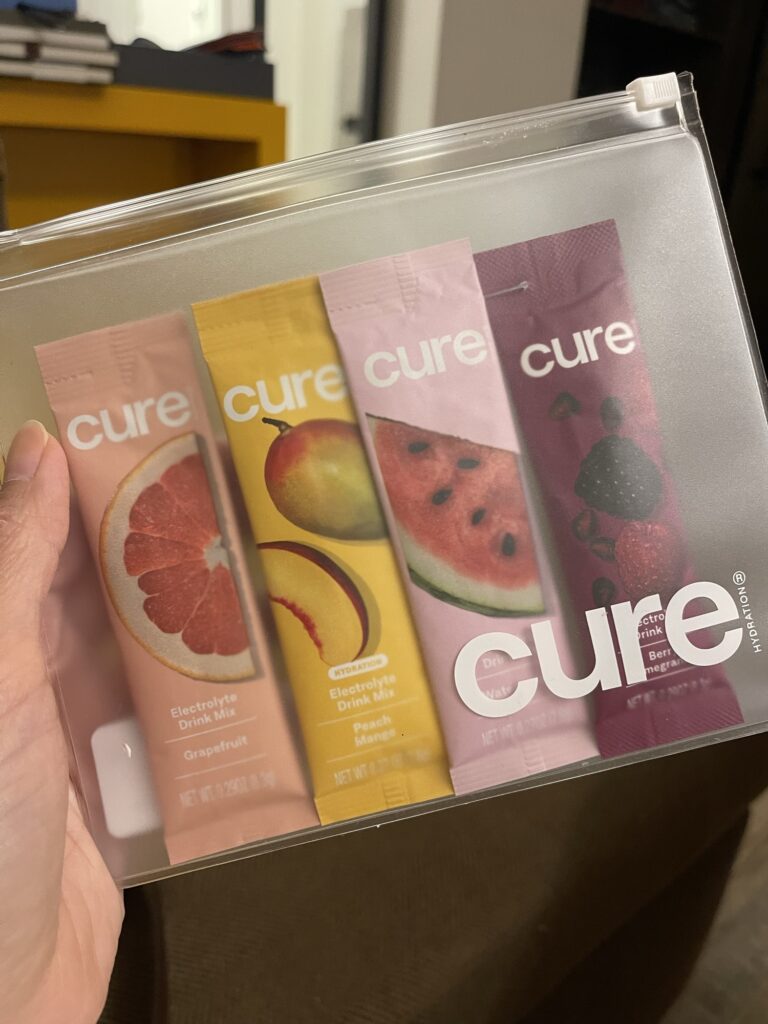
Okay, my personal favorite, and yes, I genuinely reach for this. After hot Florida runs, my go-to is Cure Hydration. It’s a plant-based powder with no added sugar (it uses coconut water and real electrolytes), and it’s what I want when I come in dripping and just need to feel human again.
What I love: it doesn’t taste like syrup, it’s not loaded with sugar for those easy-day miles, and it mixes clean without that chalky aftertaste some powders have. The lemonade and berry flavors are my rotation. If you like the idea of a simpler, plant-based ingredient list and you’re sensitive to super-sweet drinks, I think you’ll really vibe with it.
Honest cons, because that’s how I do it: because it’s a no-added-sugar formula, it is not your fueling drink for a two-hour long run or a race, you’ll still want carbs from a gel, chews, or a dedicated sports drink for those. And like most clean-ingredient products, it costs a bit more than the mega-sugar drugstore stuff. For me, the taste and the ingredient list are worth it.
If you want to try it, you can use my code LILO for a discount at checkout. Only grab it if it actually fits what you need, but if you’re after a no-sugar, plant-based everyday electrolyte, this is the one I keep restocking.
How to Actually Use Electrolytes Around Your Runs
Having a good product is step one; using it smartly is where you really feel better. Here’s my simple, real-life routine:
- Before a hot or long run: Sip an electrolyte drink 30 to 60 minutes beforehand so you start topped off, not playing catch-up.
- Short or easy runs (under ~60 min): Plain water during is usually fine. Have your electrolytes before or after, especially if it’s hot.
- Long or hot runs (60+ min): This is when you want electrolytes during, ideally with some carbs if you’re going long. Don’t wait until you’re already cramping.
- After every sweaty run: Replace what you lost. This is my Cure moment, it genuinely helps me feel less wrecked the rest of the day.
- Everyday hydration: If you’re a heavy sweater or it’s brutally hot, a no-sugar electrolyte once a day is a totally reasonable habit, not just a race-day thing.
One last honest note: listen to your body and don’t go wild with sodium if you have blood pressure concerns, check with your doctor. Electrolytes are a tool, not magic. But used right, they’ve made hot-weather running so much more enjoyable for me, and I think they can for you too. Happy running, friends. You’ve got this. 🏃♀️
Frequently Asked Questions
Do I really need electrolytes, or is water enough for running?
For short, easy runs in mild weather, plain water is usually fine. But once you’re running longer than about an hour, or sweating hard in the heat, you’re losing sodium and other minerals that water alone doesn’t replace. That’s when electrolytes help you avoid cramps, headaches, and that draggy, wiped-out feeling. If you finish runs feeling worse than you should despite drinking plenty of water, electrolytes are worth trying.
Are sugar-free electrolytes better than sports drinks for runners?
It depends on the run. Sugar-free electrolytes like Cure are great for daily hydration, short runs, hot easy miles, and recovery, because you’re getting the minerals without added sugar you didn’t burn. But for long runs or races over 60 to 90 minutes, the carbs in a traditional sports drink are actually useful fuel. My honest advice: keep a no-sugar option for everyday use and a carb option for your long, hard efforts.
How much sodium should a runner look for in an electrolyte?
Sodium is the most important number to check because it’s what you lose most in sweat. For easy or moderate runs, a serving in the low-to-mid hundreds of milligrams is usually plenty. For long, hot, sweaty efforts, you’ll want more, and heavy sweaters may need extra. Always flip to the nutrition panel and compare actual sodium milligrams rather than trusting the marketing on the front of the label.
If you are picking a hydration mix, see my Cure vs Liquid IV comparison.