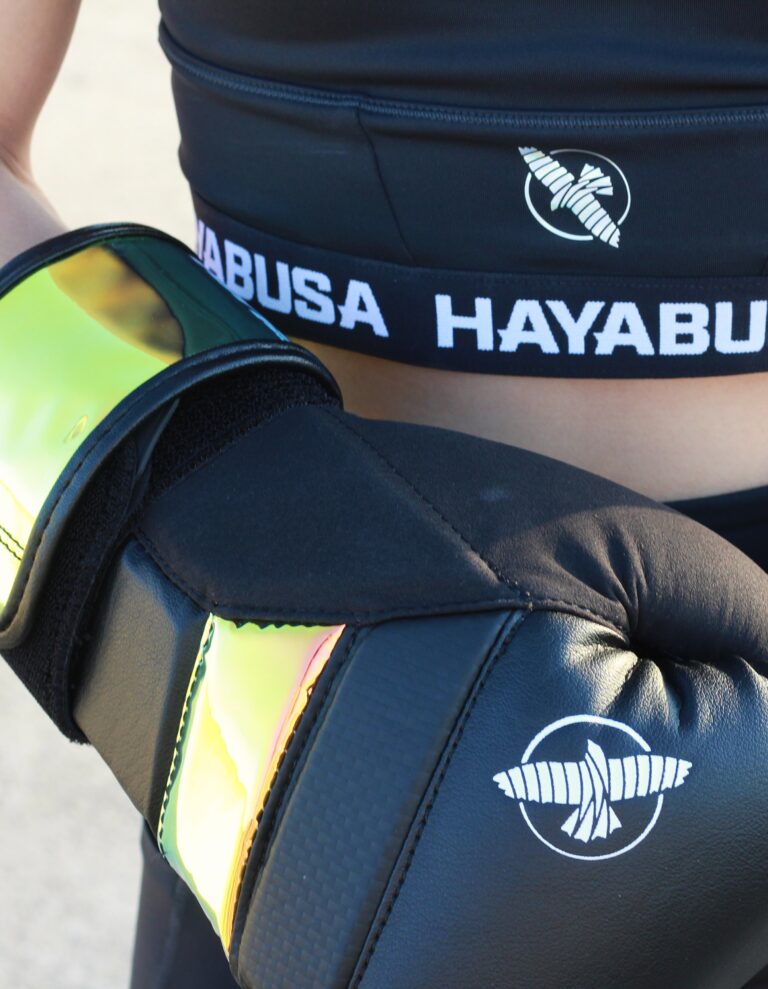



This post contains affiliate links, and I’m a Hayabusa ambassador — my code is LILO. I only ever recommend gear I actually train in. 💛
Hey friends, it’s Lizzie! I’ve had my Hayabusa T360s for about a year now, and I’ve been waiting to write this on purpose. Unboxing reviews are basically useless — every glove looks incredible on day one. What actually matters is what a glove looks and feels like after a few hundred rounds, and that’s where most gear reviews go quiet.

Why a Year Is the Honest Checkpoint
Boxing gloves don’t fail dramatically. They degrade quietly, and almost always from the inside out. The exterior can look showroom-clean while the padding underneath has gone soft enough that your knuckles start feeling the bag. That gap between “looks fine” and “is fine” is exactly why a year-in check-in tells you more than any first-impressions post ever will.
After about a decade of kickboxing I’ve gone through enough pairs to know the failure points: the foam compresses, the interior liner breaks down, the closure loses its grip, and the thumb seam is usually the first stitching to complain. So those are the four things I actually look at.
Why I Rotate Three Pairs (And Why You Probably Shouldn’t)
Full transparency on my setup, because it explains a lot about how these gloves have held up: I rotate between three pairs. My T3s in white, my T3s in pink, and the T360s. Most people genuinely do not need three pairs to interchange — I do it for training reasons, not because it’s necessary to own that many.
Here’s the actual logic. I go heavier, 14oz, when I want a cardio-intense session and to build strength — the added weight makes your shoulders work and turns a technique session into a conditioning one. Then I switch to my 12oz T360s for everyday training, when the focus is form and speed rather than load.
That rotation also means each pair gets real drying time between sessions, which is a big part of why all three are still in good shape. If you own one pair and train several times a week, that’s the single biggest disadvantage you’re working against — not the glove itself.
And the honest headline after a year: the T360s have molded perfectly to my hand and stayed perfectly intact. That’s the thing I’d want to know if I were the one buying.
The Exterior: Microfiber Leather a Year In
The T360s are built from engineered microfiber leather rather than real leather, and that choice matters more over time than people expect. Real leather cracks if you let it dry out. Microfiber doesn’t crack the same way — it scuffs instead. A year in, mine have picked up the marks you’d expect from regular bag work, but there’s no splitting at the flex points and no peeling along the seams, which is where cheaper synthetic gloves give themselves away first.
The matte finish also ages better than a glossy one. Shiny synthetic coatings show every scuff; matte just softens.
The Part That Actually Matters: Foam Compression
This is the real durability test, and it’s the one nobody checks in a first-week review. Press your thumb hard into the knuckle padding. On a new glove it resists and springs straight back. On a worn-out glove it gives easily and stays dented for a second. That’s compressed foam, and once it’s gone it does not come back — no amount of airing them out restores padding.
The layered padding in the T360 is doing what it’s supposed to here. I’m not getting that flat, jarring feedback through the knuckles on the heavy bag that signals a glove is done. If you’re shopping any glove, this is the single question worth asking anyone who’s owned them longer than a month.
The Dual-X Closure After a Year
Closures are the most underrated failure point in gloves. Standard velcro collects lint and dead fibers, and once it’s clogged it never grips properly again — you end up with a wrist that loosens mid-round, which is genuinely how people get hurt.
The Dual-X system on the T360 has held its grip better than the single-strap velcro on cheaper pairs I’ve owned. It still fastens tight and stays put through a full session. If yours ever do start collecting lint, pick it out of the hooks with your fingernail — it restores a surprising amount of grip.
Real Talk: The Smell Question
Every glove smells eventually. That’s not a brand problem, it’s a moisture problem — and it’s almost entirely down to how you dry them, not what you paid. Gloves that get zipped into a gym bag wet will smell within weeks regardless of the logo on them.
Mine are fine, and the only reason is that I never leave them in the bag. They come out the second I get home. That’s the whole trick, and it’s free.
What I’d Flag as a Downside
Being straight with you: these are not the lightest gloves on the market, and if you’re doing long mitt sessions where speed is the point, you’ll feel that weight in your shoulders by the end. That’s the tradeoff for the protection and structure — it’s a real one, and it’s worth knowing before you buy rather than after.
They’re also a genuine investment. If you’re two weeks into your first class and not yet sure you’ll stick with it, there’s no shame in starting cheaper and upgrading once you know you’re in.
Would I Buy Them Again?
Yes — with the caveat that I’d tell you to think about how you actually train first. If you’re mostly on the bag and doing technique work a few times a week, the structure and protection are worth it and they hold up. If you’re a pure speed-and-mitts person, look at a lighter model in the lineup instead.
If you do decide on a pair, my ambassador code LILO works at checkout — here’s exactly how much it saves and what it applies to.
How I Store and Dry Them (The Whole Maintenance Routine)
This is genuinely the difference between gloves that last two years and gloves that last eight months, and it costs nothing.
The moment I’m done, the gloves come out of the bag — not when I get home, not later that night. Wet gloves sealed in a gym bag are a bacteria incubator, and that’s where the smell and the liner breakdown both start. I open the closure all the way so air can actually move through the hand compartment, and leave them somewhere with airflow rather than a closed closet.
What I never do: put them near direct heat to speed things up. A radiator, a hot car, a dryer — all of that breaks down foam and adhesive far faster than sweat ever will. If they’re genuinely soaked, glove dogs or even rolled newspaper inside will pull moisture out overnight without heat.
I also wipe the interior lining down after heavy sessions. Not a deep clean, just a quick pass to keep salt from sitting in the fabric. My full cleaning routine is here if you want the detail.
What a Year Changed About How I’d Shop for Gloves
Honestly, the biggest shift is that I now think about padding density and closure design first, and looks last. It’s the reverse of how most of us shop, mine included, when we’re starting out.
Colorways sell gloves. But the two things you interact with every single round are how the padding absorbs impact and whether your wrist stays locked in — and those are the two things you cannot assess from a product photo. If I could give one piece of buying advice from this year, it’s to find someone who has owned the pair longer than a month and ask them specifically about those two things.
The other thing I’d tell my past self: a glove that fits your training beats a glove that impresses people at your gym. Nobody is looking at your gloves. You’re the only one who has to live in them.
Your Questions, Answered
How long should a pair of boxing gloves actually last? With regular training a few times a week, a well-made pair should give you a couple of years before the padding meaningfully compresses. Cheap gloves often go soft within months, which is the hidden cost of buying at the bottom of the market.
How do I know when my gloves are done? Press into the knuckle padding. If it gives easily and stays dented, or if you’re starting to feel the bag through the glove, the foam is compressed and it’s time. Exterior condition tells you almost nothing.
What’s the best way to make gloves last longer? Take them out of your bag immediately after every session and let them air dry fully. Never leave them sealed up wet, and never put them near direct heat to speed it up — that breaks down the padding and the lining.
If you are weighing this against what you trained in before Hayabusa, see T360 vs Venum.
marker,
or at the end of the body if that marker isn’t present.
Paste identically every time — the consistency is the point.
============================================================ –>
Which Hayabusa code works in my country?
Hayabusa runs separate stores by region, and each one takes a different code. Using the wrong one is the most common reason a code fails at checkout.
-
United States
Code LILO for 10% off at hayabusafight.com -
United Kingdom & Europe
Code LIZZIE for 10% off at hayabusafight.eu (hayabusafight.co.uk redirects here — same store) -
Australia
Shop my storefront at hayabusafight.com.au
One code per order, so it won’t stack with a sitewide sale — if Hayabusa’s own promotion is bigger, use theirs. Free shipping starts at $85 in the US, £80 in the UK and €180 in the EU.
Deciding between the T360 and the everyday pair? T360 vs E1.