



This post contains affiliate links. If you shop through them I may earn a small commission at no extra cost to you — I only ever recommend what I genuinely use and love. 💛
Hey friends, it’s Lizzie! If you have ever stood in front of a wall of boxing gloves — or scrolled a website full of numbers like 10oz, 12oz, 14oz — and thought “I genuinely do not know which of these is mine,” you are in extremely normal company. I have been kickboxing for about ten years and it’s still one of the questions I get most.
So let’s untangle it. This post is not a review, not a “best gloves” list, and not a size chart. It’s the how-to-think-about-weight-and-fit conversation, the way I’d have it with you at the gym before class. The accurate measurements live on the brand’s own chart.
First: oz is not a size, it’s a weight
This is the single biggest point of confusion, so let’s get it out of the way early. When a glove is listed as 12oz, that number is telling you how much the glove weighs — not how big your hand is.
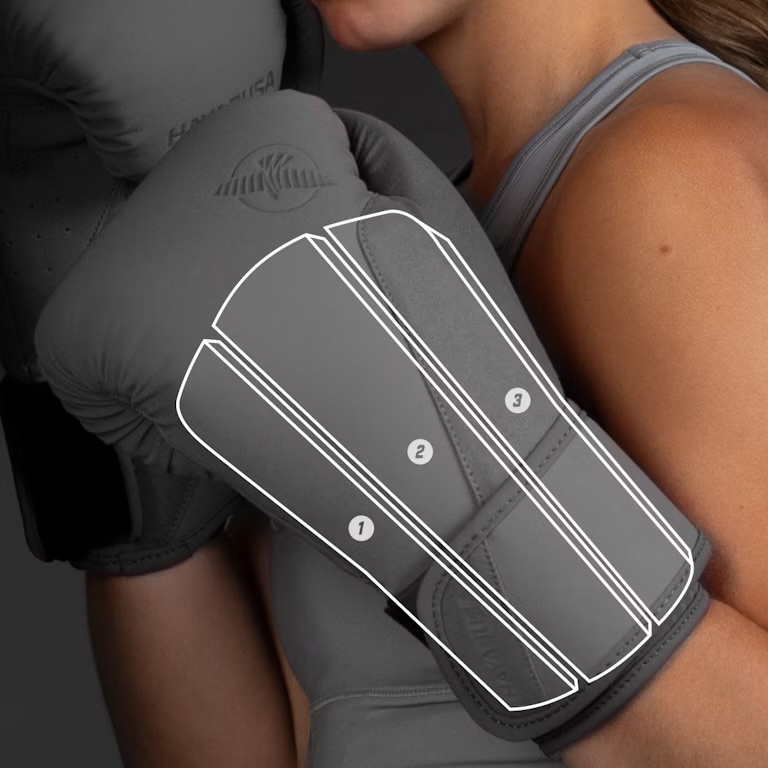
A lot of that weight is padding — and padding is the main thing that changes as you move from one weight to the next. More foam around the knuckles and across the front of the hand means more material sitting between your fist and whatever you’re hitting. You are not buying a hand measurement. You are buying an amount of protection.
This trips people up because everywhere else — shoes, jeans, rings — a bigger number means a bigger fit. Gloves don’t work that way. Going from 12oz to 14oz mainly means “more padded,” not “roomier inside.” Some brands do scale the hand compartment a bit as the ounces go up, but that varies brand to brand, so it isn’t something you can count on.
One knock-on effect: heavier gloves do tend to be bulkier on the outside, because you can’t add padding without adding bulk. That’s a byproduct, not the point.
What each weight is actually for
The cleanest way to choose is to start with what you’re doing, not with your body. Here’s the general logic:
- Lighter gloves (think the 10oz end of the range) are faster and more compact. They’re common for bag and pad work. Less padding, more feedback, more honest about your technique.
- Mid-weight gloves (12oz is the classic here) are the everyday, do-everything option for a lot of women. Enough padding for regular bag rounds without feeling like you’re swinging pillows.
- Heavier gloves (14oz and up) are the sparring end of the spectrum. More padding spreads the impact — it helps your hands, and it matters even more for the person in front of you. Plenty of gyms set 16oz as the standard for partner work.
If you want the short version: 12oz is a very common all-purpose choice for a lot of women, and it’s the answer I give most often when someone just wants one pair that works for their classes. It’s not a rule, it’s a sensible default.
Where body weight comes in (and how much it matters)
You’ll see body weight in every sizing conversation, and it does matter — but it gets overstated.
The reasoning: a bigger, stronger person generates more force, so they need more padding to absorb it safely. It’s not about hand size, it’s about impact. For most women, that tends to land in the lighter-to-middle part of the range for solo work.
But two people at the exact same weight can genuinely need different gloves depending on how hard they hit, how often they train, and how their hands have held up over the years. There is no single formula for everyday training. Competition is its own world — amateur and pro sanctioning bodies do set glove weights by weight class, so if you ever compete, the rulebook decides for you. For regular classes and bag work, though, anyone who tells you there’s one number that’s correct for your body weight is oversimplifying.
And here’s the part that overrides everything else: if you’re sparring, the sparring standard wins. Many gyms set a minimum glove weight for partner work regardless of who you are, and 16oz is the one you’ll run into most. That’s a safety rule, not a suggestion. Ask your coach what your gym requires before you buy — genuinely, before anything else in this post.
So where does hand size fit in?
Hand size is a separate question from oz, and both matter. Two gloves can both say 12oz and fit completely differently, because brands build their hand compartments differently. Some run narrow, some run wide. This is why “what oz” and “will it fit me” are two different conversations.
A few things worth factoring in:
- Your wraps count. Whatever you train in, that’s what should be on your hand when you assess fit. Thick wraps take up real space.
- Fit should be snug, not squeezed. Your hand shouldn’t slide around inside when you make a fist, and your fingers shouldn’t be jammed against the end.
- Sizing is brand-specific. Check the actual size chart on the brand’s own website rather than a general chart from a blog — including mine. I’m not going to invent measurements for you; the brand’s chart is the accurate one.
What I actually train in
I train in Hayabusa, four times a week, and I’ve been at this long enough to have opinions about my own hands. (Quick heads up: I’m a Hayabusa ambassador, so if you shop through my link or code I may earn a commission at no extra cost to you.)
What I’d pass along from a decade of this is less about the number: I care more about wrist support and consistent fit than about shaving off ounces. Lighter gloves feel great for a few rounds, but I’d personally rather have a glove that locks my wrist in place than one that saves me a couple of ounces — and wrist support comes from how the cuff and strap are built, not just from the weight. That’s my preference, not medical advice. If you’ve got wrist pain or an old injury, that’s a conversation for your coach or a doctor, not a blog post.
Something else that took me too long to figure out: many people eventually end up with two pairs, lighter for bags and pads, heavier for sparring. You do not need that on day one. Buy one good mid-weight pair and let your training tell you what the second pair should be.
To make that concrete with my own kit: I keep 12oz T360s for the sessions where the focus is form and speed rather than load, and I go to my T3s when I am actually putting weight through my hands. Same hands, same week — the weight changes with what the session is asking for, not with anything about my body. That is the part most weight charts leave out. I wrote about how I run that rotation in why I rotate my boxing gloves.
The short answer
If you’re brand new and mostly doing classes and bag work, a mid-weight glove around 12oz is a reasonable place to start. If you’re sparring, go heavier and follow your gym’s rule, which is often 16oz. If you’re between options, check the brand’s size chart with your wraps on, and pick the one that feels secure at the wrist.
That’s genuinely it. The number matters less than people think, and the fit matters more.
Shopping Hayabusa?
For the long version: my full Hayabusa T3 review after 10 years training.
One thing that saves people money: my verified Hayabusa discount code.
My code LILO works at checkout.
If that sounds like you: how long a pair actually lasts.
Your Questions, Answered
Is 12oz or 14oz better for a beginner woman? For general classes, bag work and pad work, 12oz is a common starting point for a lot of women and tends to feel balanced rather than bulky. 14oz makes more sense if you’re sparring, or if you know you hit hard and want extra padding — though be aware many gyms require 16oz for partner work, so check before you spend. If your gym has a required minimum weight for sparring, that rule should decide it for you. Ask your coach before you buy.
Does a heavier glove mean a bigger glove? Not in the way most people assume. The oz number describes the glove’s weight, and the extra ounces mostly go into padding, not interior space. Heavier gloves do end up bulkier on the outside because the extra foam has to go somewhere, and a few brands scale the hand compartment slightly as the ounces go up — but that varies brand to brand, so going up in ounces isn’t a reliable way to get a roomier fit. If the issue is that a glove is too tight on your hand, that’s a fit and brand-shape question, not an ounces question.
Can I use the same gloves for bag work and sparring? Sometimes, but it depends on your gym. Plenty of people use one mid-weight pair for everything early on. Once you start sparring regularly, many gyms require a heavier glove for partner work — 16oz is the most common requirement — and at that point a second pair makes sense: a lighter one for bags and pads, a heavier one for sparring. There’s no need to buy both up front. Start with one good pair and let your training tell you when you need the second.
Related reading
- Best Boxing Gloves for Beginners (2026)
- Best Boxing Gloves for Heavy Bag Work (What I Actually Use)
- Best Boxing Gloves for Women: The Complete Buyer’s Guide
- Best Boxing Gloves Under $100 (I Have Owned Every One)
- 5 Boxing Glove Mistakes Beginners Make (and How to Fix Them)
- Buying Your First Hayabusa: What I Tell Beginners