


Heads up, friends: this post has affiliate links. As an Amazon Associate I earn from qualifying purchases, at no extra cost to you. I only ever share what I actually use. 💛
Hey friends, it's Lizzie! I'm firmly in my driving-range era: buckets of balls, a lot of laughing at myself, and a first full eighteen holes on the calendar. Brandon and I go together, and lately I've been going on my own to practice too. The range is the least intimidating place in golf, and it still has rules that nobody explains at the counter. Here is everything I've figured out so far, as a beginner, so your first bucket is about your swing and not about whether you're standing in the wrong place.
At the counter
- Start with a small bucket. A big bucket feels like value and turns into a sore back and a bad mood. Fifty-ish balls is plenty for a first session, and you can always buy another.
- Ask how the bays work. Some ranges assign a bay, some are first-come. Some have mats, some grass, some both. Just ask; the counter answers this forty times a day.
- Rent clubs if you don't own any. You do not need a full set to hit a bucket. Most ranges rent a few clubs, and a beginner can learn plenty with one or two.
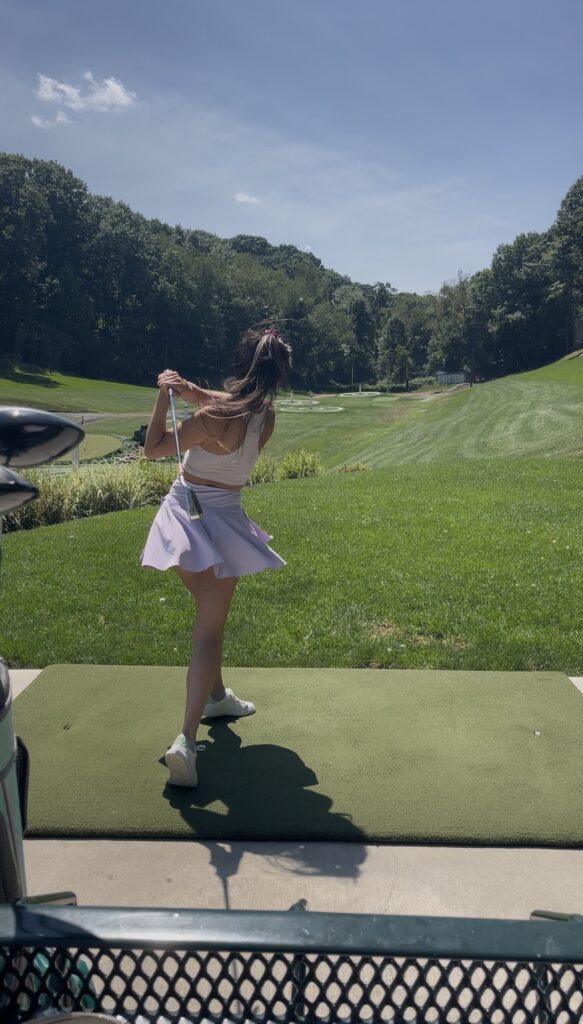
Picking a bay
Leave an empty bay between you and the next person when you can. It gives everyone room to swing and makes the whole thing less self-conscious. If it's busy and you have to go next to someone, that's fine, just be aware of their backswing. And if the range has an end bay, grab it: one neighbor instead of two is a gift when you're new.
The safety rules that are not optional
- Never walk behind someone mid-swing. Wait until they've hit, then pass. A club moving at full speed does not care that you were in a hurry.
- Stay behind the line. If a range has a line or rope at the front of the bays, you do not cross it, ever, even for a ball that rolled two feet forward.
- When the ball-picker cart is out, keep hitting or don't, but don't aim at it. Yes, people do. Don't be people.
- Hit one ball at a time. Tee one up or pull one onto the mat, hit it, then the next. Raking three onto the mat at once looks efficient and is how you take a club to the shin.
Pace and noise
You don't need to rush, and you don't need to rip through a bucket in fifteen minutes. But if the range is busy and people are waiting, hit at a reasonable pace and don't sit in a bay scrolling your phone. Keep music in your headphones, keep conversation at normal volume, and don't narrate your neighbor's swing. They didn't ask, and neither did you.
What I actually wear and bring
Real talk: the range has never cared what I wear. I show up in a matching set with built-in shorts, regular sneakers or my Tory Burch ones, a visor or a hair bow, and a glove I picked up on Amazon, the one golf thing I bought myself. It made the club feel more secure in my hands. The clubs and balls were a gift: a friend gave me a complete pink RAM Axial women's set of clubs and a set of pink golf balls to start. Sunscreen, sunglasses and a full water bottle, because Florida. That's the whole list, and it's all in my golf list below. I don't own golf shoes, and I'm not buying any until I know I want them.
Range habits that made me less terrible
- Warm up with a short club. Start with a wedge or a short iron and work up.
- Pick a target. Aim at a flag or a yardage sign, even on the mat.
- Take a break between ten balls. Step back, breathe, reset. The worst swings tend to come in the middle of a rushed string.
- Leave a few balls in the bucket. Ending on a decent shot beats ending on the forty-ninth tired one.
If you're planning your first real round
A quick look at the course's website or a two-minute phone call to check the dress code saves you an awkward moment at check-in. And a few range sessions before your first eighteen make the whole day a lot more fun. That's my plan, anyway. I'll report back.
Range, lessons, or YouTube: where I'd put the first bit of money
Real talk: I'd rather put money into range time and lessons than into shoes or a full set of clubs. YouTube is free and useful for understanding what a swing is supposed to look like, and it is completely useless for telling you what yours actually looks like. A single lesson with a coach who watches you swing fixes things a hundred videos can't, because they can see your grip and your feet. The range is where you practice what the lesson told you. If you can only afford one of the three, buy the lesson and hit small buckets to practice it.
Common range mistakes in the first few visits
- Watching the person next to you. Their swing is not your swing, and comparing can ruin a whole bucket.
- Trying to fix three things at once. One thought per swing. Two if you're feeling ambitious. Three is chaos.
If you're going with someone better than you
Tell them you want to hit your own bucket at your own pace, and ask them to save the advice for after unless you ask. A friend who golfs well can be the best thing about your first range day or the worst, and the difference is whether they narrate your swing. The best range partner is the one who hits their own bucket, cheers when you connect, and says nothing about your elbow.
The point of the range, honestly
It's to make the first real round less scary. Every bucket takes a little fear out of the first tee. So don't treat the range as a test you have to pass before you're allowed on a course; treat it as the place where you get to be bad in private, cheaply, in a cute set. That's what I'm doing, and I'm having a great time being terrible.
🛍️ My Amazon list: Golf
The sets, the visor and the glove I actually take to the range, all in one place.
Your Questions, Answered
Do you need golf shoes at the driving range? I play in regular sneakers and nobody has ever looked twice. Some courses have dress codes for a full round, so check before your first eighteen.
How much does a bucket of balls cost? It varies by range, and a small bucket is always the cheapest way to start. Ask at the counter, buy small, and buy another if you still have energy.
Can a beginner go to the driving range alone? Yes, and honestly it is the best way to start. Nobody is watching you, the counter will explain how the bays work, and you can go at your own pace with a small bucket.