


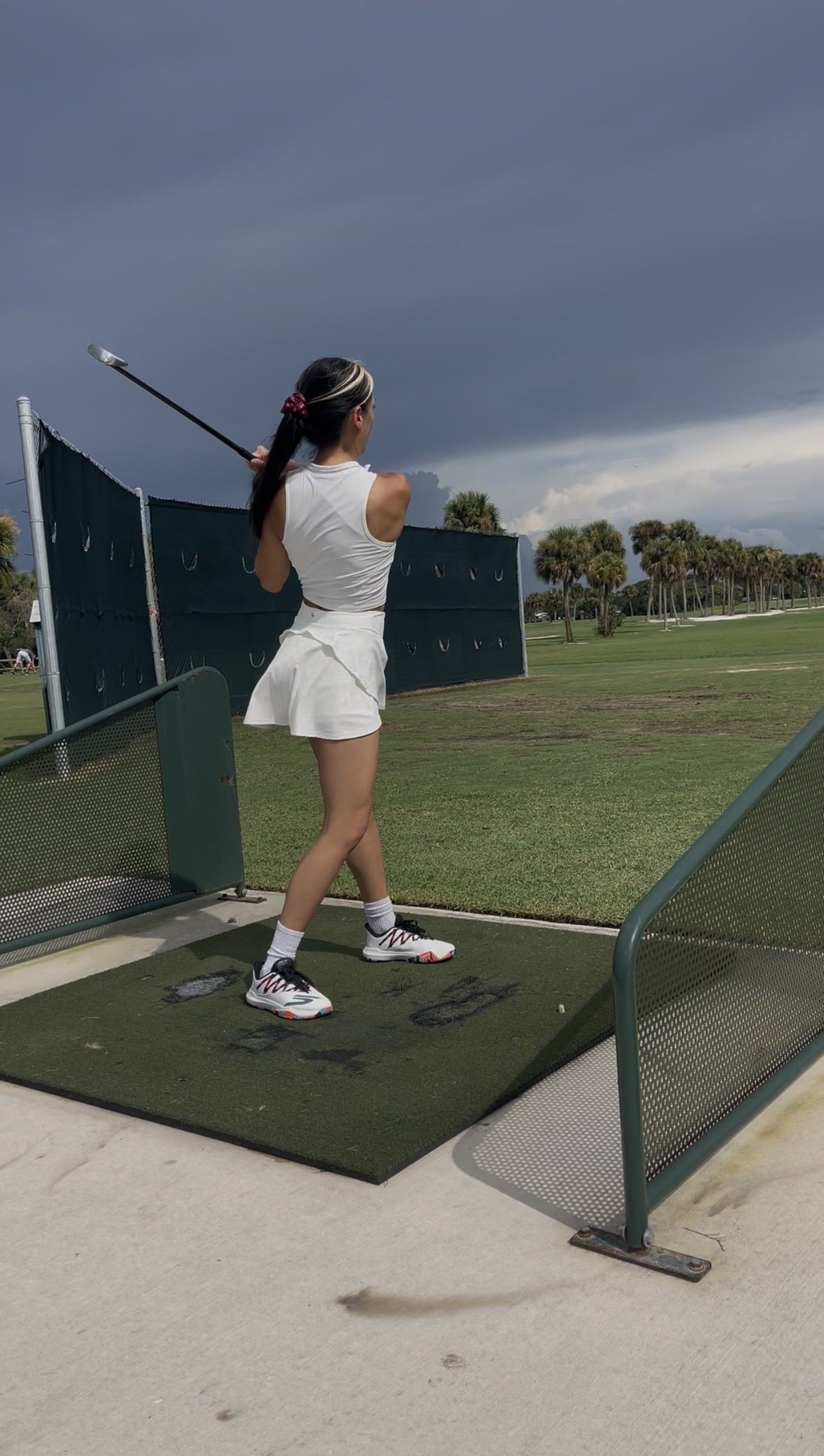
Hey friends, it’s Lizzie! Somewhere between kickboxing four times a week and running this whole “30s are actually the best decade” campaign, I decided I needed a new item on the bucket list. So I am learning to play golf — and this week I took the very first, very humbling step: my first real trip to the driving range.
I want to be honest about this one, because most golf content online comes from people who already know what they are doing. I do not. I am a 10-year kickboxer who is used to being decent at physical things on day one, and golf handed me a reality check within the first bucket of balls.
Why Golf, Why Now
Your 30s are when you stop waiting to be “good” at something before you try it. I have spent a decade building real skill in one sport, and there is something almost freeing about being a total beginner again — no ego, no expectations, just seeing what happens when I actually swing a club instead of throwing a punch.
Golf also fits the life I am building right now: something Brandon and I can do together as a couple, something social, something outdoors on the Space Coast, and honestly, something that gets me out of the gym mindset for an hour. It is the opposite muscle from kickboxing in every way, and that is exactly the point.
My First Trip to the Driving Range
I will spare you the play-by-play of every whiffed swing, but here is the honest version: the first bucket of balls was mostly me relearning how my own body works. Kickboxing trained my hips and shoulders to rotate a very specific way for a very different purpose, and golf wants something else entirely. My first few swings felt like fighting my own instincts.
What surprised me most was how much golf rewards patience over power — the opposite of throwing a hook. The swings that actually connected well were the slow, controlled ones, not the ones where I tried to swing like I was aiming for a heavy bag. That is going to take some unlearning.
By the end of the bucket, I was making contact more often than not, and a few actually went semi-straight. Small wins, but on day one of anything new, small wins are the whole game.
What I’d Tell You Before Your First Driving Range Trip
If golf is on your own 30s bucket list, here is what I wish I had known walking in:
- You do not need your own clubs yet. Most driving ranges rent a basic set, which is exactly how you should start before spending real money on gear you might not stick with.
- Get the big bucket. It is worth your time to actually practice, not just dip a toe in — more reps is more progress. Some ranges even let you bring a drink and do not put you on a clock, so there is no real upside to cutting yourself short with a small one.
- Comfortable shoes and clothes you can rotate in matter more than looking the part. This is not the day for anything restrictive — though honestly, for me that is not much of a sacrifice. I am always dressed for the occasion, so this was just a great excuse to whip out one of my activewear sets.
- Go in expecting to feel uncoordinated. If you already have an athletic background like I do, that can almost work against you at first — your body wants to move the way it already knows.
I will keep sharing this as it becomes an actual skill instead of a first attempt — consider this the opening entry, not the highlight reel.
What I’d Do Differently Next Time
Two things. I’d have asked someone to check my grip before I built up a hundred reps of doing it my own way — grip is the one thing that’s genuinely hard to self-correct later, and it costs nothing to have someone look at it once.
And I’d have brought less. I overthought what to bring for something that turned out to need almost nothing: comfortable shoes, water, and a willingness to be bad at something in public for an hour.
The Part That Surprised Me Most
How quiet it is. I expected the range to feel like a gym — busy, a bit competitive, people noticing each other. It’s the opposite. Everyone is completely absorbed in their own thing, nobody is watching, and there’s a rhythm to it that’s genuinely calming.
That was the thing that made me want to go back, more than any particular shot. It’s one of the few activities I’ve tried where an hour disappears without a phone in my hand.
Where This Fits With Everything Else I Do
Coming from kickboxing, the contrast is the whole appeal. One is explosive and fast and leaves you wrecked; the other is slow, precise, and mostly mental. Having both means I’ve got something for high-energy days and something for the days I want to be outside without destroying myself.
If you already train hard at something, golf is a surprisingly good second sport for exactly that reason — it asks for a completely different kind of attention.
Your Questions, Answered
Do I need my own clubs for a first driving range trip? No. Nearly every range rents clubs, and most will let you borrow a single iron if you just want to hit a bucket. Buying before your first session is the most common beginner mistake.
How many balls should a beginner hit? A small bucket, usually around 40–50 balls. Any more and your form falls apart from fatigue, which just teaches your body the wrong swing.
Is the driving range beginner-friendly, or will people stare? Ranges are genuinely the least intimidating place in golf. Everyone there is practising, which means everyone is missing shots too.
Is it too late to start learning golf in your 30s? Not even a little. Golf is one of the few sports where beginners of any age can play alongside experienced players without it being awkward, and most people who play recreationally started as adults.
What should I bring to my first driving range visit? Comfortable athletic clothes you can rotate in, closed-toe shoes, and honestly not much else — most ranges rent clubs, so you do not need to invest in gear before you know if you like it.
Does an athletic background help with golf? It helps with fitness and coordination generally, but do not expect it to translate directly. Golf uses a different movement pattern than most sports, and I found my kickboxing instincts occasionally worked against me at first.