

This post contains affiliate links. If you shop through them I may earn a small commission at no extra cost to you — I only ever recommend what I genuinely use and love. 💛
Hey friends, it’s Lizzie! People ask what’s actually in my gym bag more than almost any other question, so here’s the honest, unglamorous answer — what I actually pack for training, not a wishlist of things I own but never use.
🥊 Shop my bag in one order
My T3s, my blue E1s, the shin guards and the mouthpiece: everything Hayabusa in this bag. Put it in one order and code LILO takes 10% off. It is one code per order, so if a sitewide sale bigger than 10% is running, take the sale instead.
The Gloves, Obviously
My Hayabusa T3s live in the bag permanently. Ten years in, and the wrist support is still the thing I’d miss most if I switched brands. Code LILO knocks 10% off if you’re building your own kit: shop Hayabusa here.
What’s Underneath the Gloves
Hand wraps, always, even for a light bag session. Mine are Hayabusa. The Perfect Stretch pair is the one I would always put in my cart, and I love my Captain Marvel pair too, though I don't see those in the store right now. I keep two pairs in rotation so there’s always a dry set — one pair drying out from the last session while the other one’s in use. Skipping wraps is the fastest way to a wrist injury that keeps you out for weeks, and it is genuinely not worth the two minutes you save.
Why There Are Two Pairs of Gloves in There Now
Ten years in, the bag has a second pair: my blue Hayabusa E1s. The T3s are still the favorites and still what I reach for on sparring days and any session I know will be a real one. The E1s are softer and absorb more of the punch, so they’re my long heavy-bag pair. The practical reason for two pairs is simpler than that, though: gloves need a full day to dry out, and a second pair means neither one gets worn while it’s still damp. I went into the whole habit in why I rotate my boxing gloves.
The Protective Gear That Moved In
Two things live in the bag that aren’t gloves: shin guards and a mouthpiece, both Hayabusa.
The shin guards are the better story. For a long while I trained in a slip-on style pair from Sanabul, and I genuinely liked them. They fit me well, which as a petite person is not something I take for granted with fight gear. When I switched to Hayabusa they were simply more comfortable, with a better fit and feel, and they haven’t left the bag since. That’s not a knock on the Sanabuls. It’s just what happened when I tried the upgrade.
The mouthpiece is a Hayabusa too. It’s the smallest thing in the bag and the one I’d be most annoyed to forget.
What’s not in there: headgear. I don’t own any. If your gym requires it for sparring, that’s a conversation to have with your coach, not with me.
What I Actually Train In
Since people ask: the shorts in my bag rotate between two brands. One is Athena Fightwear, the black-and-gold and red-and-white Muay Thai pairs. They’re cut for women, with built-in safety shorts, which matters more than you’d think the first time you throw a high kick in a class full of mirrors. Code SEALILLLY takes 10% off at Athena.
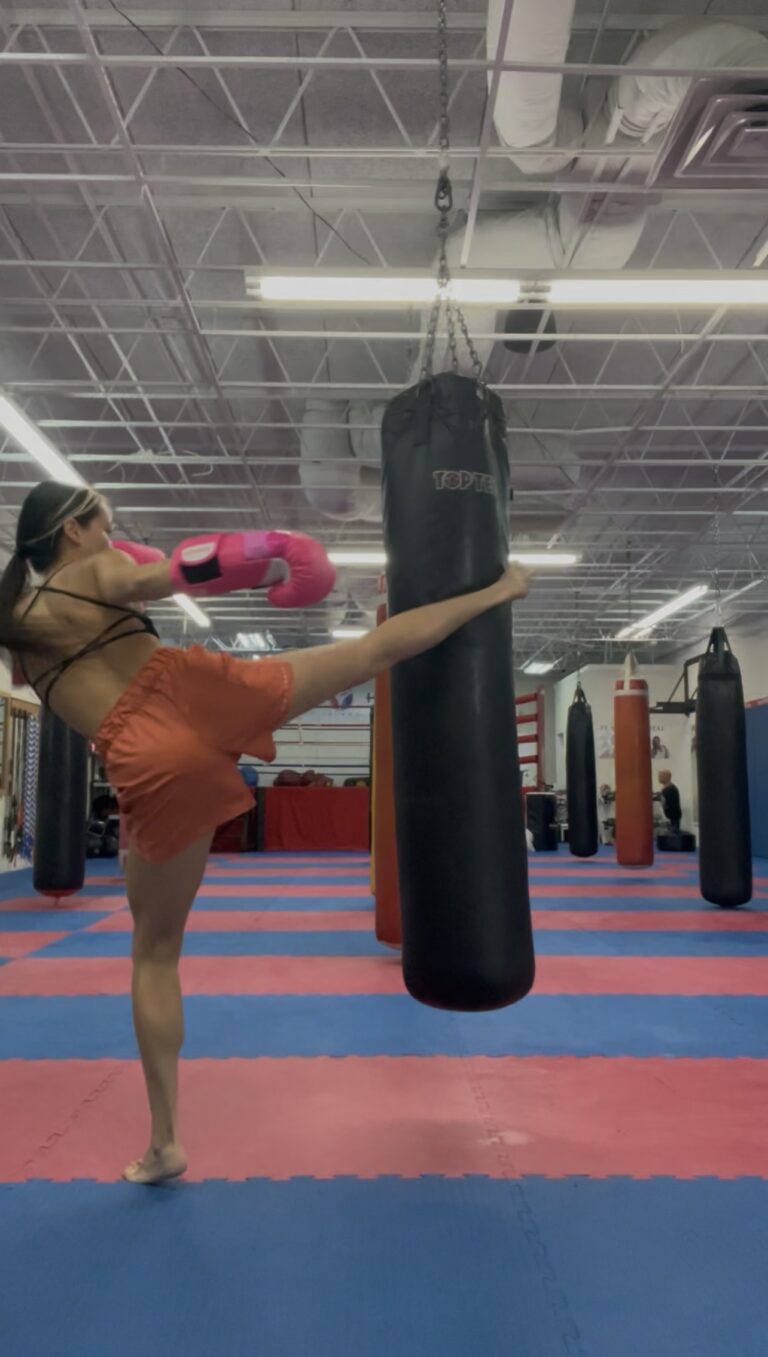
The other is Hayabusa's women's fight shorts in orange, which I wear a lot. That pair and the Hayabusa hoodie I love get their own post: the Hayabusa apparel I actually wear.
The Unglamorous Stuff That Actually Matters
A second small bag just for sweaty gear, so it’s not touching anything clean on the way home. A travel-size deodorizing spray for the gloves themselves — moisture is the whole reason gear starts to smell, and airing them out plus a quick spray after every session has kept mine from ever getting genuinely bad. A hair tie doubled on my wrist, because I will absolutely lose the first one mid-round. These days it’s a Teleties, because they’re the ones that actually hold a pony through a full round.
Fuel and Hydration
Water, obviously, but also something with electrolytes if it’s a longer or more intense session — training in Florida heat is a different sport than training in air conditioning. I keep a protein shaker with me too, mostly because I know myself well enough to know I won’t eat properly right after a hard session unless the option is already sitting in my bag.
The electrolyte packets in there are Cure, and my code LILO works there too.
What I Deliberately Don’t Bring
My phone stays in the car, not the gym bag. I know that’s not universal advice, but training is the one hour of my day nobody can reach me, and I protect that on purpose. I also don’t bring a change of “cute” workout clothes to post about later — if I’m filming content that day, I plan for it separately. Training time and content time are different things for me.
My must-have Hayabusa cart
If I could only put three things in my cart, it would be these. Prices as of October 7, 2026:
- T3 Boxing Gloves, White/Iridescent, 14 oz: $169.00
- Women's Apex Vantage Fight Shorts, Sunset Coral: $79.99
- Perfect Stretch Hand Wraps, Black, 180 in: $19.99
That is $268.98 before the code. With LILO in that cart, checkout took $26.89 off, so $242.09 before shipping. It is one code per order, so if a sitewide sale bigger than 10% is running, take the sale instead. Shop Hayabusa →
Building Your Own Version of This
You don’t need all of this on day one. Gloves and wraps first, everything else gets added as you figure out your own actual habits rather than what you think you’re supposed to bring. My bag looked nothing like this a year into training — it’s built from trial and error, not a shopping list.
How I Pack It So Nothing Rots
The single most useful habit I have with this bag: everything damp comes out the moment I get home. Not later, not tomorrow. Gloves, wraps, towel — all of it out and airing. This is the difference between gear that lasts years and gear that smells permanently after a few months.
I also keep the wet stuff and the dry stuff separated inside the bag rather than letting a sweaty towel sit against clean clothes. A simple second pouch handles it, and it means the bag itself stays fresher too.
What I Learned the Expensive Way
Two things, both of which cost me gear before I figured them out.
First, never leave gloves in a hot car. Heat is far harder on padding and adhesive than sweat is, and a Florida car in August is genuinely brutal on equipment. Second, one pair of wraps is not enough if you train more than twice a week — they don’t dry fast enough, and putting damp wraps back on is how the smell problem starts.
The Bag Itself
Worth saying: the bag matters less than people think, with one exception — ventilation. A completely sealed gym bag traps moisture around everything inside it. Mesh panels, or even just leaving it unzipped between sessions, does more for your gear’s lifespan than any specific brand of bag.
Size-wise, err smaller than you think. A big bag encourages you to carry things you never use, and you end up hauling a lot of dead weight to and from the gym.
Building a Bag on a Smaller Budget
If you’re starting out and don’t want to spend much, the priority order is simple. Wraps first — they’re cheap and they protect your hands and extend the life of whatever gloves you buy. Then gloves. Then everything else is genuinely optional and can wait until you know you’re sticking with it.
Everything in my bag accumulated over about a decade of training. Nobody needs to assemble this in one purchase, and honestly you shouldn’t — you don’t know what you actually want until you’ve trained for a few months.
Packing for a Class vs. Open Gym
These need different bags and people tend to over-pack for both. For a structured class, you need less than you think — the equipment is usually there, so it’s gloves, wraps, water, towel. For open gym or bag work, you’re more on your own and it’s worth having your own everything.
If you’re traveling to train somewhere new, call ahead about what’s provided. Most gyms will tell you exactly what to bring, and it saves hauling gear across a city for nothing.
🥊 My whole kit is one order: Hayabusa
My T3s, my E1s, my shin guards and my mouthpiece are all Hayabusa. LILO comes off the whole cart of full-price gear, one code per order; if a bigger sitewide sale is running, take the sale and skip my code.
💧 The packets in my bottle: Cure
The electrolyte packets that live in my gym bag. Code LILO at checkout.
Your Questions, Answered
Do I need two pairs of hand wraps? Not on day one, but it’s one of the first upgrades worth making once you’re training more than once a week — a dry pair every session matters more than people expect.
What’s the one thing you’d never train without? Hand wraps. I’d rather forget almost anything else in the bag before I’d skip wrapping my hands.
Do you actually use everything you recommend? Yes — this list is genuinely what’s in my bag right now, not a curated version for the post. If something didn’t earn its spot, it’s not on here.
What protective gear do you own besides gloves? Hayabusa shin guards and a Hayabusa mouthpiece. No headgear.
🥊 My gloves: Hayabusa T3 — code LILO for 10% off. Shop Hayabusa →
Now tell me, friends: what’s the one thing in your gym bag you’d never train without? Drop it in the comments. Come find me on Instagram @sealillly. Love you, mean it. 🥊
If you are choosing a protein, I compared the two I know best in Rule One vs Optimum Nutrition.
Why there is more than one pair in there: my glove rotation.